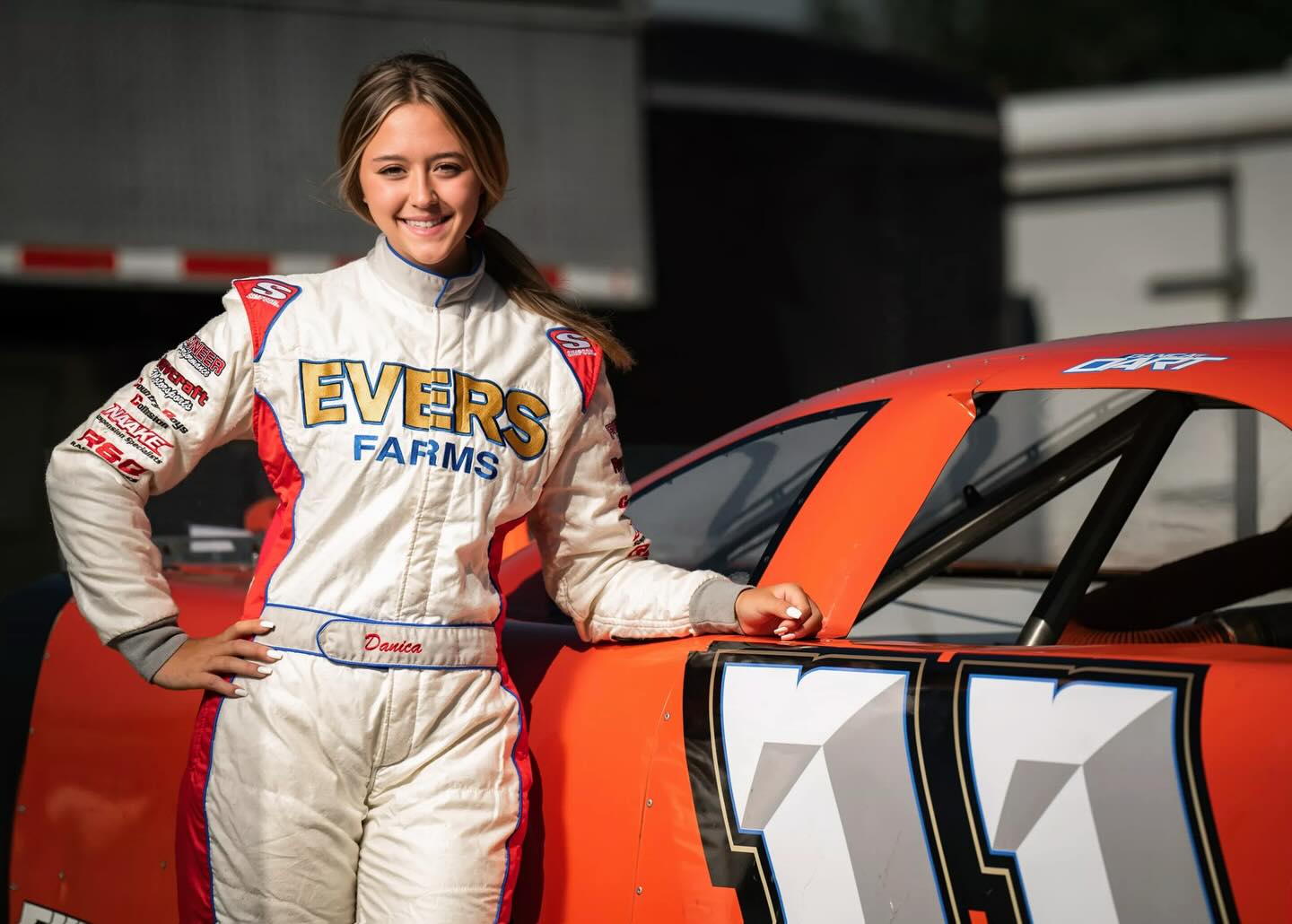
Danica Dart
IndyCar racer // American
click to enlarge
Danica's Socials:


Share Danica’s Profile:
Danica's Details:
Danica's IMPORTANT LINKS:





Danica's
MEDIA
LATEST News:
(click “NEWS” tab to see all)
LATEST GRRL! OG VIDS:
(click “G! VIDS” tab to see all)
LATEST YOUTUBE VIDS:
(click “YT VIDS” tab to see all)
Danica's OG GRRL! VIDEOS:
Danica's bio:
She dropped out of high school at sixteen to chase checkered flags in England, won the biggest race of her IndyCar career in Japan, and became the first woman to lead laps at Indianapolis and snag pole position at the Daytona 500—all while silencing critics who doubted whether her marketability outweighed her talent.
EARLY YEARS
Born March 25, 1982, in Beloit, Wisconsin, Danica Sue Patrick grew up in the Midwest with gasoline already in her veins. Before she could legally drive a car on public roads, she was winning regional and national go-kart titles, racking up hardware with the kind of consistency that made it clear this wasn’t just a weekend hobby. At sixteen, when most teenagers are stressing over geometry tests and homecoming dates, Danica made a decision that would define her life: she dropped out of high school and moved to England to compete in junior road racing series, including Formula Vauxhall and Formula Ford. It was a gutsy move, the kind that either launches a career or crashes spectacularly. For her, it was the former—her runner-up finish at the Formula Ford Festival at Brands Hatch remains the highest by an American in the event’s history, a performance that caught the attention of Bobby Rahal, the Indianapolis 500 champion who would eventually sign her and shepherd her career.
OTHER INTERESTS
Details about Danica’s life outside the cockpit remain sparse in the public record. After retiring from professional racing in 2018, she transitioned into hosting, though specifics about the platform or show format aren’t widely documented. What is clear is that racing consumed the lion’s share of her focus for most of her life—when you’re bouncing between continents as a teenager and later juggling IndyCar and NASCAR schedules, hobbies tend to take a backseat.
EARLY SUCCESS
Funding—or the lack of it—forced Danica back to the United States in 2001, a harsh reminder that talent alone doesn’t always pay the bills in motorsports. But Bobby Rahal believed in her, signing her to Rahal Letterman Racing in 2002 for five races in the Barber Dodge Pro Series. By 2003, she was competing in the Toyota Atlantic Series, and by 2004, she finished third in the championship standings, becoming the first woman to win a pole position in the series. That same year, her performance solidified her reputation as more than just a promising prospect—she was the real deal. In 2005, she made the leap to the IndyCar Series, and her rookie season at the Indianapolis 500 became instant legend. She led nineteen laps—the first woman ever to do so—and finished fourth, the highest finish by a woman in the race’s history at that time. She earned Rookie of the Year honors for both the Indy 500 and the full IRL season, finishing twelfth in the championship standings. Later that year, she became only the second woman to win a pole position in IRL history, doing so at Kansas Speedway. Critics could no longer dismiss her as hype.
NOTABLE ACHIEVEMENTS
- 2004: Third place in Toyota Atlantic championship standings; first woman to win pole position in the series[1].
- 2005: Led 19 laps at Indianapolis 500, finishing fourth (highest finish by a woman); named Indy 500 Rookie of the Year and IRL Rookie of the Year; won pole at Kansas Speedway (second woman in IRL history); finished twelfth in IndyCar standings; named IRL Most Popular Driver[1][2][3][4].
- 2006: Continued with Rahal Letterman Racing in IndyCar[1].
- 2007: Moved to Andretti Green Racing; named IRL Most Popular Driver for third consecutive year[1][3].
- 2008: Won the Firestone IndyCar 300 at Twin Ring Motegi, Japan, on April 20—first woman to win a major IndyCar event; finished 5.86 seconds ahead of Hélio Castroneves in her fiftieth IRL start; finished sixth in IndyCar drivers’ standings[1][3][4][6].
- 2009: Finished third at Indianapolis 500 (career-high); finished fifth in IndyCar championship standings[1].
- 2010: Raced in ARCA and NASCAR Nationwide series[1].
- 2011: Finished sixth in ARCA race at Daytona; finished fourth at NASCAR Nationwide race in Las Vegas (best finish by a woman in a national NASCAR series at the time)[1].
- 2012: Joined Stewart-Haas Racing for NASCAR Nationwide and Cup series[1][6].
- 2013: Won pole position for Daytona 500 (first woman to do so); began full-time NASCAR Cup series competition[1][2][3].
- 2015: Set record for most top-ten finishes by a woman in NASCAR Cup series (seven)[6].
- 2016: Won Monster Energy Fan Vote three times for NASCAR All-Star Race (only repeat winner)[6].
- 2017: Finished fourth in Clash at Daytona (best NASCAR Cup finish)[1].
- 2018: Retired from professional racing[1][2].
INSPIRATIONS
While the research provides no direct statements from Danica about her personal heroes or what sparked her passion for racing, Bobby Rahal clearly played a pivotal role as both mentor and believer. His decision to sign her in 2002 gave her the platform to prove herself, and his credibility as an Indianapolis 500 champion lent weight to her potential at a time when skepticism about female drivers was rampant.
REPUTATION
Danica’s career sits at a complicated intersection of groundbreaking achievement and polarizing debate. In IndyCar, she earned genuine respect—her 2008 win at Twin Ring Motegi silenced critics who had dismissed her as merely a marketing phenomenon, and her multiple strong finishes at Indianapolis cemented her as a serious competitor in a male-dominated sport. She brought sponsorship dollars and mainstream attention to open-wheel racing during a turbulent era marked by the Champ Car and IRL split. When she moved to NASCAR full-time in 2013, the results were less flattering. Her on-track performance—while historic in some respects, like winning pole at Daytona—was widely regarded as a bust relative to expectations, though she did set the record for top-ten finishes by a woman with seven. Still, her ability to draw sponsorships and eyeballs to NASCAR during a period of declining interest was undeniable. The fan vote results—winning three times for the Monster Energy All-Star Race and being the only repeat winner—showed that her popularity transcended lap times. Whether she was a trailblazer or a missed opportunity depends on who’s talking, but no one can argue she didn’t leave a mark.
FUTURE GOALS/PLANS
Danica retired from professional racing in 2018 and transitioned into hosting, though details about her current projects or long-term ambitions remain undocumented in available sources. For a driver who spent decades under intense scrutiny, perhaps the absence of a public roadmap is intentional—a chance to define success on her own terms, away from the stopwatch.
References:
Wikipedia – Danica Patrick
Biography.com – Danica Patrick
Britannica – Danica Patrick
Speakers.com – Danica Patrick
Speedway Report – What Danica Patrick’s Career Meant to Motorsports
DanicaPatrick.com – Danica
coming…
coming…
coming…
coming…
More Badasses You Should Know...
Yuika Hosokawa
Lucie Baud
Gina Bovaird

Jacqueline Kreutzpointner