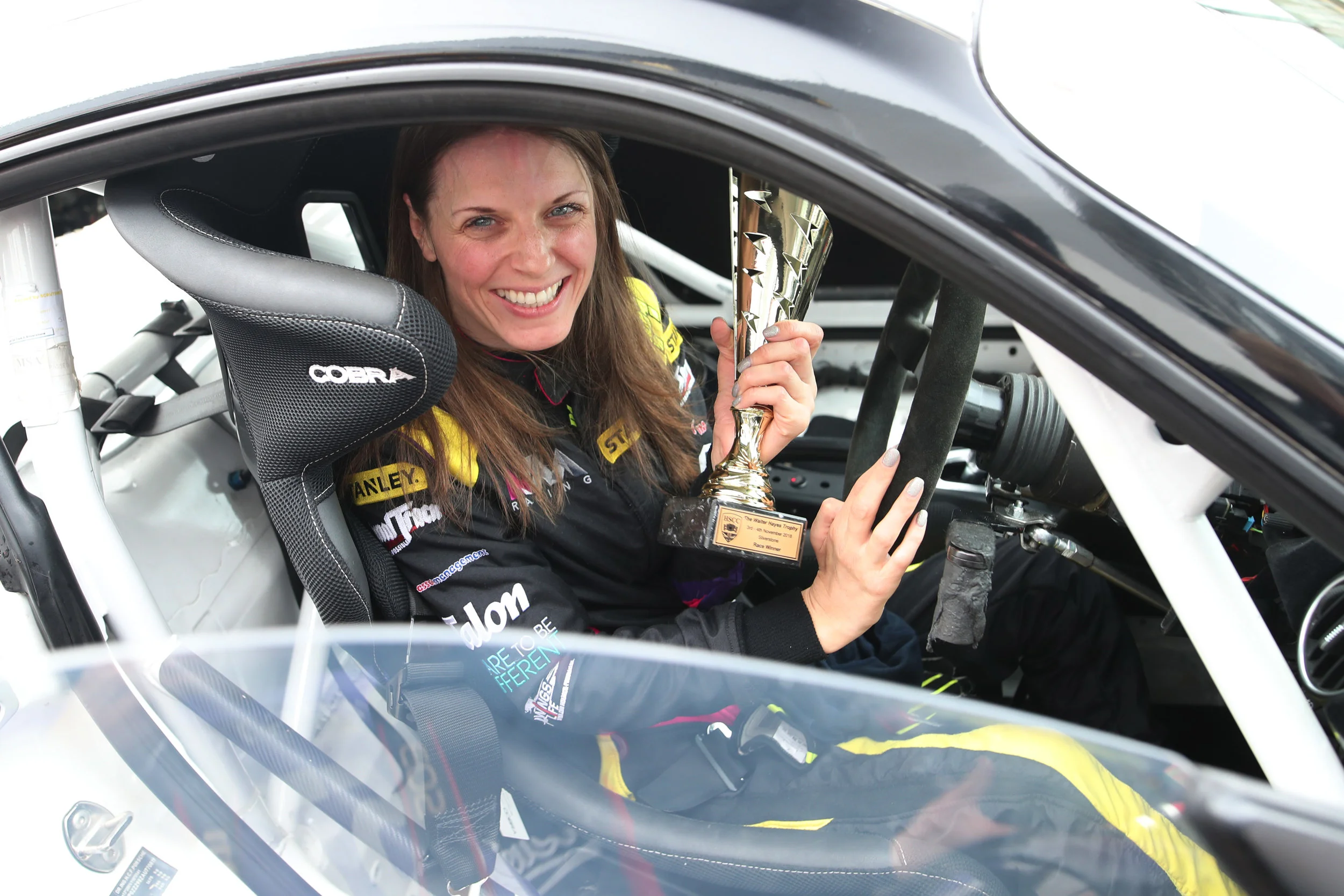
Bio Excerpt: Nathalie McGloin became the world’s only female tetraplegic racing driver after a car accident at 16 left her paralyzed from the chest down. The former wheelchair rugby pioneer discovered racing through a trackday invitation and was instantly hooked by the equality of competing against able-bodied drivers.... (full bio below ↓↓)
Nathalie Mcgloin
Rally racer
click to enlarge
Nathalie's Socials:


Failure isn’t a weakness, it’s a tool to make us stronger.
Nathalie's Details:
Nathalie's Sponsors:
YOUR SPONSORS LOGOS HERE
YOUR SPONSORS LOGOS HERE
YOUR SPONSORS LOGOS HERE
Nathalie's full bio:
Nathalie McGloin is the world’s only female tetraplegic racing driver, competing wheel-to-wheel against able-bodied men in hand-controlled Porsches across British national championships while simultaneously serving as President of the FIA Disability and Accessibility Commission.
EARLY YEARS
Born around 1983 in Northampton, United Kingdom, Nathalie McGloin’s life took a devastating turn at age 16 when a serious car accident left her paralyzed from the chest down. The teenager from Northamptonshire faced a future that looked nothing like the one she’d imagined—confined to a wheelchair, navigating a world built for bodies that worked differently than hers now did.
But McGloin wasn’t the type to accept limitations quietly. She found her first taste of post-accident adrenaline through wheelchair rugby, becoming the first female wheelchair rugby player in the United Kingdom. The sport became what she describes as “pretty much a full-time job,” demanding the kind of physical commitment and competitive fire that would later translate seamlessly to the racetrack. It was through rugby that she’d find her way back to speed—a rugby friend invited her to a trackday to pit his able-bodied Porsche 911 against his new BMW M3, never imagining he was about to change her life entirely.
That trackday, sometime after 2013, flipped a switch. “I was instantly addicted to the speed,” McGloin recalled, “but the fact I could do it at the same time and in the same way as able-bodied people was a freedom. People were interested in the controls of my car. I hadn’t had that before. I was there as an equal, I fitted into an able-bodied world—something I hadn’t experienced before.” The girl who’d earned a university degree despite her disability had found something even formal education couldn’t provide: absolute, uncompromising equality measured in lap times and corner speed.
OTHER INTERESTS
When she’s not strapped into a race car, McGloin channels her competitive energy into making motorsport accessible for others like her. In 2016, she co-founded Spinal Track with Graham Bayliss, a charity that provides track and rally experiences for disabled drivers using specially adapted cars. The operation isn’t small-time charity window dressing—Spinal Track runs three track cars and four rally cars, hosting ten track days and ten rally days annually, giving approximately 100 drivers per year the same rush of equality and freedom McGloin discovered on that first trackday.
She’s also an inspirational speaker, delivering keynotes worldwide about disability in motorsports and encouraging women and disabled people into the sport. It’s advocacy work that’s taken her from conference stages to the highest levels of racing governance, spreading the gospel that “anything is possible” to audiences who need to hear it from someone who’s actually done the impossible.
Her garage reveals a woman who doesn’t just talk about racing—she lives it. McGloin owns a Lamborghini Huracán Performante and a Urus, the kind of automotive collection that speaks to both speed addiction and the hard-earned success that makes such toys possible.
EARLY SUCCESS
McGloin’s path to competition wasn’t straightforward. After that life-changing trackday, she progressed through increasingly rapid road cars before spending 18 months from 2014 to 2015 adapting a Porsche 987 Cayman S for racing. Her first competitive outings in 2014 were sprints in an Audi A4 Avant diesel and a Porsche 997 Turbo—unglamorous validation runs to prove she could handle the license requirements.
In 2015, McGloin achieved what she’d initially joked might “just hang on the wall with my university degree”—she became the first female with a spinal cord injury to earn a UK racing license. She immediately put it to use in the Porsche Club Championship Class 1, campaigning her hand-controlled Cayman S. There was a learning curve, naturally. During testing at Brands Hatch, she drifted into the gravel and found her car teetering on two wheels—the kind of moment that might have ended another driver’s racing dreams before they properly started. McGloin just figured out the controls and kept pushing.
By November 2017, she’d earned her first podium finish—third in class in the Classic Sports Car Club series. The following year brought a second-place class finish and, finally, her first race win in 2018 in the CSCC series. “I’m not going to pretend I wasn’t petrified before my first race,” she admitted, “but all the hard work had been worth it.” She’d proven what she’d set out to prove: that a tetraplegic woman could race wheel-to-wheel with able-bodied men in 40-minute circuit events on slick tires and actually win.
McGloin’s appetite for firsts didn’t stop at circuit racing. In 2019, she became the first female with a disability to earn a UK rally license, adding dirt and gravel to her repertoire of speed. By then, she was competing in three British national championships simultaneously, running approximately seven circuit races per year from March to October—an impressive schedule for any racer, let alone one managing the physical demands of quadriplegia alongside the usual racing challenges.
NOTABLE ACHIEVEMENTS
- 2015: First female with a spinal cord injury to earn a UK racing license; began competing in Porsche Club Championship Class 1 with hand-controlled Cayman S.
- 2016: Co-founded Spinal Track charity with Graham Bayliss to provide track and rally experiences for disabled drivers.
- 2017: Appointed President of the FIA Disability and Accessibility Commission following a speech to FIA President Jean Todt, becoming the youngest FIA Commission President and one of only two female presidents; earned first podium finish (3rd in class, CSCC) in November.
- 2018: Achieved first race win in CSCC series; earned 2nd place class finish in CSCC.
- 2019: First female with a disability to earn a UK rally license; earned first silverware.
- Undated: Guinness World Record as first female quadriplegic driver to compete in a race; first disabled person to present podium trophy at Formula 1 British Grand Prix.
INSPIRATIONS
McGloin’s motivations appear to be internal rather than derived from racing heroes or family influence. “I like being the first to do things,” she’s said plainly. “It’s a motivator to me to prove it can be done.” That streak of pioneering determination—the same drive that made her the UK’s first female wheelchair rugby player—powers every first she chases on the track. The equality she discovered at that first trackday remains her north star: the radical idea that lap times don’t care about the mechanics of your spine, only the speed of your hands and the sharpness of your mind.
REPUTATION
Within motorsport, McGloin has earned recognition that extends far beyond inspiration porn. When FIA President Jean Todt heard her speak in 2017, he didn’t just applaud—he invited her to head the FIA’s Disability and Accessibility Commission, trusting a then-34-year-old racer to shape accessibility policy across Formula 1, GP circuits, and Formula E venues worldwide. Her goal was ambitious: FIA Disabled Access Status certification for all major circuits by the end of 2019, pushing for accessible facilities not just for drivers but for volunteers, officials, and spectators.
Media coverage consistently frames McGloin as a pioneering figure, and the tone is earned rather than patronizing. She’s featured in Porsche’s official newsroom, Lamborghini’s brand content, and motorsports publications that recognize her determination and talent alongside her barrier-breaking achievements. Peers note that she doesn’t ask for special consideration—she races the same cars, the same tracks, the same rules as everyone else, just with hand controls replacing foot pedals.
McGloin takes an unsentimental view of her “challenges.” “I wouldn’t call them challenges,” she’s said. “Any racing driver has things that they need to work around.” Her mental preparation is identical to able-bodied competitors, and her race craft speaks for itself through podiums and wins. She’s become a role model not by asking for sympathy but by refusing to accept that her disability makes her less capable—then proving it with trophies.
The racer who jokes about liking to be first has backed up that personality trait with an extraordinary list of actual firsts, from wheelchair rugby to racing licenses to FIA leadership. “So many people reach out to me about how they can get into the sport,” she’s noted. “I wanted to give people the same opportunity I had.” Through Spinal Track, where every donation goes fully to the charity rather than overhead, she’s turned that desire into 100 annual opportunities for disabled drivers to experience what she discovered: that speed is the great equalizer.
FUTURE GOALS/PLANS
McGloin has indicated racing is “something I’d be doing for a long time to come,” though specific 2025 plans aren’t publicly documented. Her broader mission remains clear: “Making Motorsport for Everyone.” Through her FIA commission role, she continues pushing for accessible circuits and inclusive licensing processes across global motorsport. The expensive nature of racing means she remains dependent on sponsor support for her approximately seven annual circuit races, but her dual role as competitor and accessibility advocate suggests she’s in this for the long game—not just her own racing career, but fundamentally changing who gets to participate in motorsport at every level.
References:
evo.co.uk Article/Interview
New Mobility Magazine Profile
Nathalie McGloin Racing Official Website
Porsche Newsroom Article
Shorty Awards Profile
Lamborghini News
Equal Everywhere Profile
Champions Speakers Agency
Loudspeaker Agency Profile