Kumi Sato
Formula racer
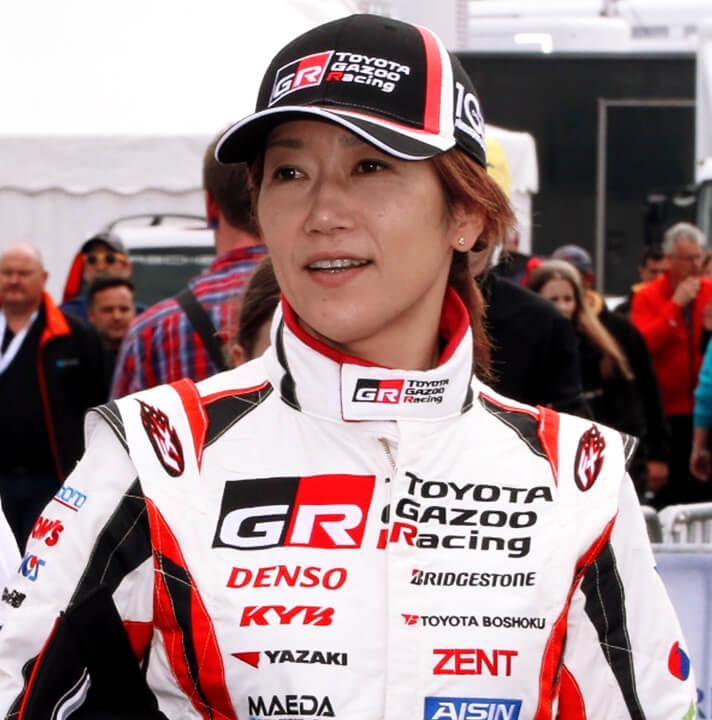
click to enlarge
Kumi's Socials:
Share Kumi’s Profile:
Kumi's Details:
Kumi's IMPORTANT LINKS:





Kumi's
MEDIA
LATEST News:
(click “NEWS” tab to see all)
LATEST GRRL! OG VIDS:
(click “G! VIDS” tab to see all)
LATEST YOUTUBE VIDS:
(click “YT VIDS” tab to see all)
Kumi's OG GRRL! VIDEOS:
Kumi's YOUTUBE VIDS:
Kumi's bio:
Kumi Sato is a pioneering Japanese racing driver who became the first woman to compete in what is now Super GT, holding the all-time records for most starts and championship points by a female driver in the series. A university-educated pharmacist turned racer and automotive journalist, she’s built a decades-long career spanning endurance racing from Japan to Germany’s legendary Nürburgring.
EARLY YEARS
Details about Kumi Sato’s childhood, family background, and early years remain largely undocumented. What is known is that she pursued higher education with characteristic determination, graduating from university with a pharmacist qualification—a solid, respectable career path that most would have followed straight into a pharmacy. But Sato had other plans. While still at university, she discovered racing, and that first taste of speed in her early twenties changed everything. By 1990, she’d begun competing in what is now known as the Super Taikyu Endurance Series, trading the sterile precision of pharmaceutical work for the controlled chaos of endurance racing. Not exactly the career trajectory her pharmacology professors had in mind.
OTHER INTERESTS
Beyond the racetrack, Sato has carved out a successful career as an automotive journalist, reviewing civilian cars with the same analytical eye she brings to racing. She’s described as well-travelled, suggesting someone who doesn’t just race in different countries but actually explores them—a quality that likely serves her well when navigating unfamiliar circuits. Her pharmacist qualification hints at a scientific, detail-oriented mind, the kind that appreciates data, precision, and methodology. Whether that academic rigor translates to how she analyzes telemetry or simply helps her write more informed car reviews is anyone’s guess, but it certainly sets her apart in a field where not everyone bothered with university, let alone a professional degree.
EARLY SUCCESS
Sato spent the first seven years of her racing career honing her skills in the Super Taikyu Endurance Series before making the leap that would define her legacy. On August 10, 1997, she became the first woman ever to compete in the All Japan GT Championship (JGTC), now known as Super GT, driving for Kraft team in the GT300 class. Her weapon of choice? A Toyota Cavalier—essentially a rebadged Chevrolet Cavalier, front-wheel drive, and about as uncompetitive as it sounds in a field dominated by purpose-built rear-drive Porsches and other GT machinery. Yet in just her second race at Miné Circuit in 1997, Sato piloted that unglamorous Cavalier to a fourth-place finish, outperforming several Porsches in the process. It remains the highest finish ever achieved by a woman in Super GT history—a record that still stands. Not bad for someone racing what was essentially a tarted-up family sedan.
NOTABLE ACHIEVEMENTS
- 1990: Began racing career in what is now the Super Taikyu Endurance Series.
- 1997: Became the first woman to compete in the All Japan GT Championship (JGTC), now Super GT, debuting August 10 in a Toyota Cavalier for Kraft team in the GT300 class.
- 1997: Achieved fourth-place finish at Miné Circuit in her second race, the highest finish ever by a woman in Super GT, outperforming Porsches despite driving a front-wheel-drive Toyota Cavalier.
- Career: Competed in five seasons of Super GT, recording 20 career starts and accumulating 34 championship points—both all-time records for a woman in the series.
- 2012: Won the SP3 class at the Nürburgring 24 Hours with Toyota Gazoo Racing.
- 2014: Claimed her second SP3 class victory at the Nürburgring 24 Hours with Toyota Gazoo Racing.
- Ongoing: Competed in rallying driving a Toyota GT86, and maintained steady presence with Toyota Gazoo Racing at Nürburgring 24 Hours (as of 2017, had competed in the event for five consecutive years).
INSPIRATIONS
No information is available about the racing drivers, family members, mentors, or experiences that inspired Sato’s career or influenced her path into motorsports.
REPUTATION
Sato is widely recognized as a pioneer for women in Japanese motorsports, with her groundbreaking 1997 debut opening doors that had remained firmly closed. Her ability to extract competitive performances from uncompetitive machinery—like that fourth-place finish in a front-drive Cavalier against proper GT cars—earned respect in the paddock and demonstrated skill that transcended equipment limitations. Media coverage consistently highlights her pioneering status and record-setting achievements, framing her as tangible proof of changing opportunities for women in Super GT. Her long-term relationship with Toyota, including factory efforts with Gazoo Racing, speaks to the trust and respect she’s earned within one of motorsport’s most prominent manufacturers. She’s not just a footnote in racing history as “the first woman to…”—she’s a driver who showed up, delivered results, and kept coming back for more, building a multi-decade career across multiple disciplines and continents.
FUTURE GOALS/PLANS
No information is available about Sato’s current racing commitments, future plans, or goals beyond 2017. As of the most recent documentation, she remained active with Toyota Gazoo Racing at the Nürburgring 24 Hours and continued her work as an automotive journalist.
References:
Celebrating the women of Super GT – SuperGTWorld
The First Woman To Race In The All Japan Grand Touring… – Jalopnik
Kumi Sato – Speedqueens
Toyota Gazoo Racing Archive
World Car Awards Juror Profile
coming…
coming…
coming…
coming…
More Badasses You Should Know...

Mathilde Denis

Lyn St. James

Eileen Bildman

Paige Decker
