Camille Du Gast
Rally racer // French
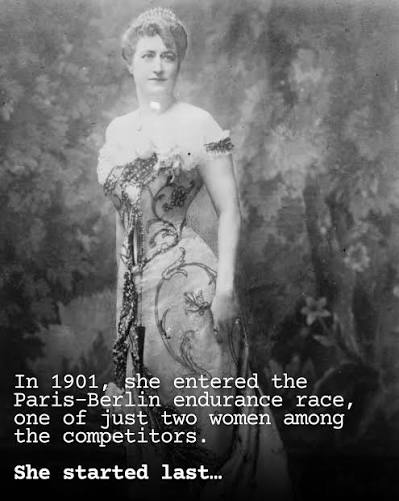
click to enlarge
“The danger of an accident is always present in my mind, though I am never afraid.”
Camille's Socials:

Share Camille’s Profile:
Camille's Details:
Camille's IMPORTANT LINKS:





Camille's
MEDIA
LATEST News:
(click “NEWS” tab to see all)
LATEST GRRL! OG VIDS:
(click “G! VIDS” tab to see all)
LATEST YOUTUBE VIDS:
(click “YT VIDS” tab to see all)
Camille's OG GRRL! VIDEOS:
Camille's bio:
Camille Du Gast was a Parisian socialite who became one of the first women to compete in international automobile racing — and one of the most consequential figures in the sport’s early history. The FIA recognizes her as the first woman to race consistently at international level. [1]
EARLY YEARS
Born Marie Marthe Camille Desinge in Paris on May 30, 1868, into a wealthy family with roots in northern France, she grew up in the French capital during the Belle Époque. [2] [3] Historical accounts describe her as a tomboy in that milieu — a characterization that her adult pursuits would do little to contradict. [4]
Her range of physical interests was, by any era’s standards, formidable. She studied piano with Félix Le Couppey, performed as a pianist, and sang at charity concerts. [5] Outside the concert hall, she pursued mountaineering, fencing, pistol and rifle shooting, skiing, and — when young — hunting on foot or horseback. [5] No schools or formal education records appear in the sources consulted.
The automobile entered her life in 1900, when she watched the Gordon Bennett Cup race start. [6] She was immediately drawn to the new sport. Accounts differ on the precise timing and circumstances of her first car acquisitions — one version holds that she purchased a Peugeot and a Panhard herself after watching the 1900 race; another attributes the purchase to her husband in 1901. [3] [7] Either way, by 1901 she was ready to race.
OTHER INTERESTS
Camille Du Gast’s life off the road was as crowded as her racing career was brief. She advocated for animal protection and campaigned against bullfighting, eventually becoming president of France’s Society for the Prevention of Cruelty to Animals — the SPA — in 1929, and using her own funds to expand and modernize an animal shelter at Gennevilliers. [5]
She also served as vice-president of the Ligue Française du Droit des femmes and campaigned alongside suffragists for women’s voting rights. [5] Historical profiles record that she created and funded dispensaries in Paris for orphans and unmarried mothers. [5] The pattern — personal wealth directed toward causes others had overlooked — runs through her life as consistently as the speed did.
EARLY SUCCESS
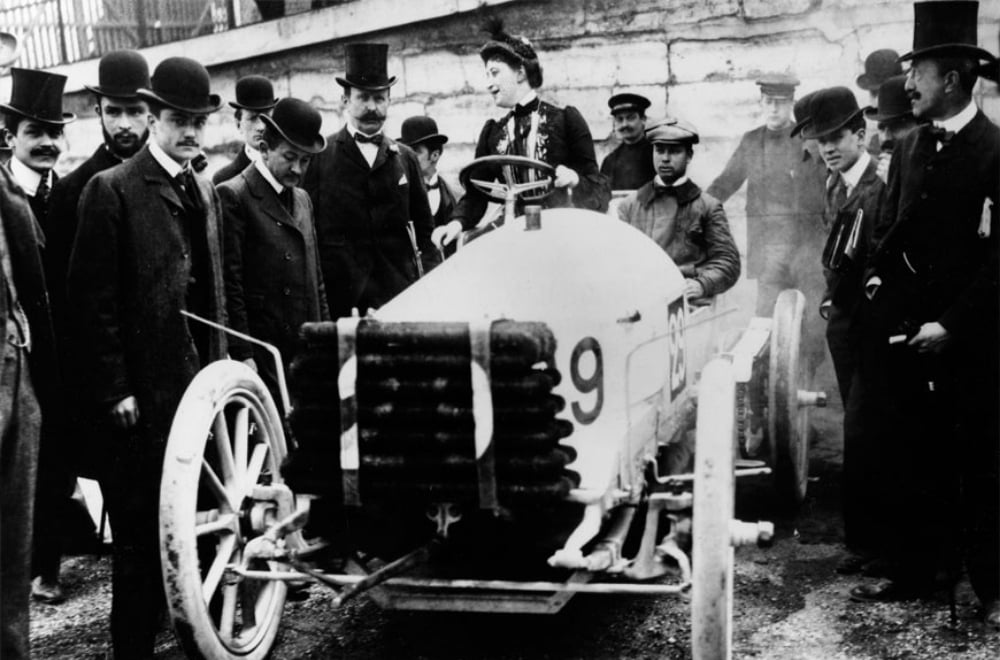
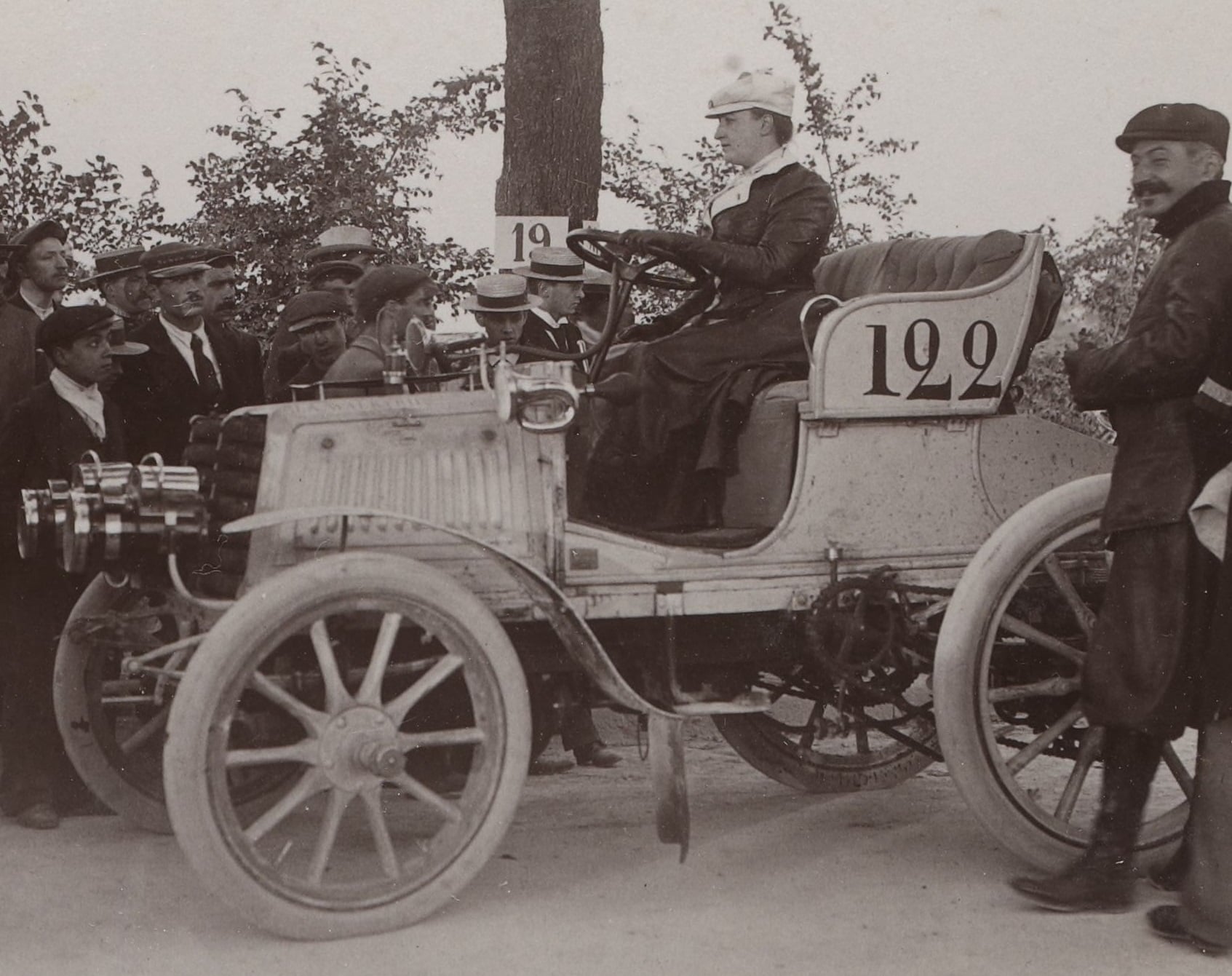
Her first documented automobile competition was the 1901 Paris–Berlin race. She started last among 122 entrants, driving a 20hp Panhard in the heavy class, with Hélie de Talleyrand-Périgord, the Prince du Sagan, as her riding mechanic. [8] That she started at all was already a statement. That she finished — 33rd overall and 19th in her class, according to Beaulieu, or approximately 30th overall in the FIA’s less precise account — was something else. [8] [1]
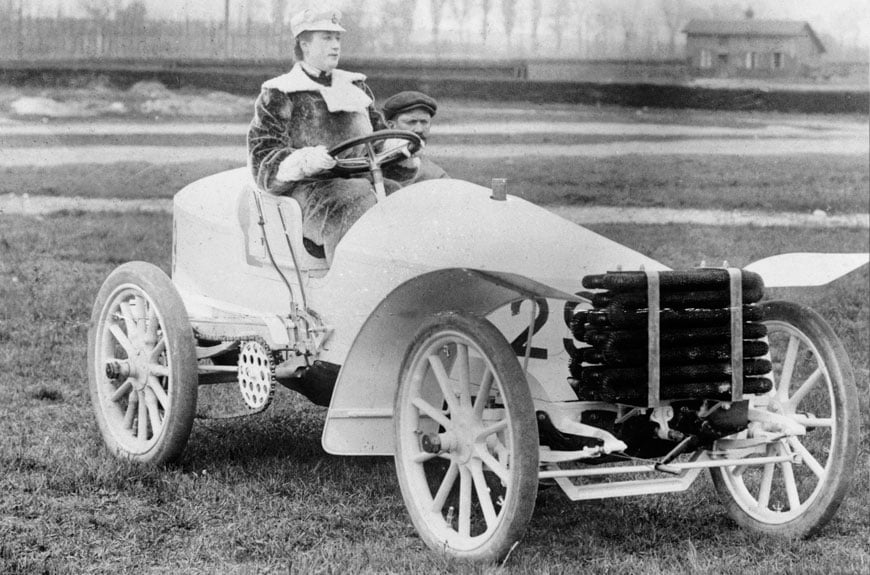
Two years later, in 1903, she entered the Paris–Madrid race in a works 5.7-litre, 30hp De Dietrich, starting 29th. [8] The race is remembered today as one of the bloodiest in the sport’s history: mechanical chaos and uncontrolled spectator crowds turned the roads into a disaster. During the event, Du Gast reached eighth place before pulling over to assist the injured driver Phil Stead, who had crashed his De Dietrich. [8] She restarted and continued to Bordeaux, where the race was halted by government order. Whether she finished 44th or 77th at that point depends on which source you consult — the records are unresolved. [8] [7]
Her response to Phil Stead’s crash drew considerable attention. In a race defined by carnage, stopping to help a fallen competitor was not the expected behavior. That it was a woman who stopped — and then restarted — made it a story that traveled. Spectators at the 1903 Paris–Madrid start had already applauded her before the flag dropped. [8]
In 1904, the Automobile Club de France closed its membership to women and excluded her. She challenged the decision and lost. [5] After that, she turned to powerboat racing. [1]
NOTABLE ACHIEVEMENTS
- 1901: Competed in the Paris–Berlin race as one of the first French women to enter a major international automobile race, finishing 33rd overall and 19th in the heavy class from a field of 122 starters. [8]
- 1903: Reached eighth place in the Paris–Madrid race before stopping to render assistance to injured driver Phil Stead, then resumed to reach Bordeaux where the race was halted. [8]
- 1929: Became president of France’s Society for the Prevention of Cruelty to Animals (SPA), funding the expansion and modernization of an animal shelter at Gennevilliers. [5]
- Ongoing recognition: The FIA identifies her as “the first woman to race consistently at international level.” [1]
INSPIRATIONS
The documented origin of her racing interest is a single event: watching the 1900 Gordon Bennett Cup. [6] No person is recorded in the sources consulted as having influenced or encouraged her. She came to motorsport through observation, not introduction — and from the moment she entered, she operated on her own terms.
Her own words about driving suggest something more intimate than ambition. “I have full control of my car,” she said. “I feel that she obeys me. …You know it almost like you know yourself.” [3] And on the question of fear: “The danger of an accident is always present in my mind, though I am never afraid.” [3]
REPUTATION
The FIA describes Camille Du Gast as “one of France’s most famous female racing drivers” and credits her as the first woman to race consistently at international level. [1] Those designations, a century on, have held. Her active career in automobile racing spanned just 1901 to 1903 — two documented races in two years — yet the impact has outlasted the brevity. [8]
The 1903 Paris–Madrid incident fixed her reputation in a particular way. In a race that killed multiple drivers and mechanics and prompted the French government to ban city-to-city racing altogether, Du Gast was the competitor who stopped for a stranger. The crowds at the start had cheered her. History has been similarly warm. [8]
Her exclusion from the Automobile Club de France in 1904 — which she fought and lost — stands as a reminder that institutional motorsport was not inclined to reward what she had demonstrated on the road. [5] The record she left, however, required no membership to stand.
References:
[1] FIA — Women Through the Decades
[2] Janine Tissot / FDAF
[3] Bonjour Paris — Camille du Gast: The Motoring Legend of the Belle Époque
[4] Library of Congress — Camille du Gast
[5] GEO — Qui était Camille du Gast?
[6] The Motor Museum in Miniature — Camille du Gast
[7] Henry Ford — Women in the Winner’s Circle: Camille du Gast (PDF)
[8] Beaulieu — Women in Motorsport: Camille du Gast
coming…
coming…
coming…
coming…
More Badasses You Should Know...

Kayla Mozeris

Jianna Evaristo

Rebecca Evans

Rhianna Purcocks