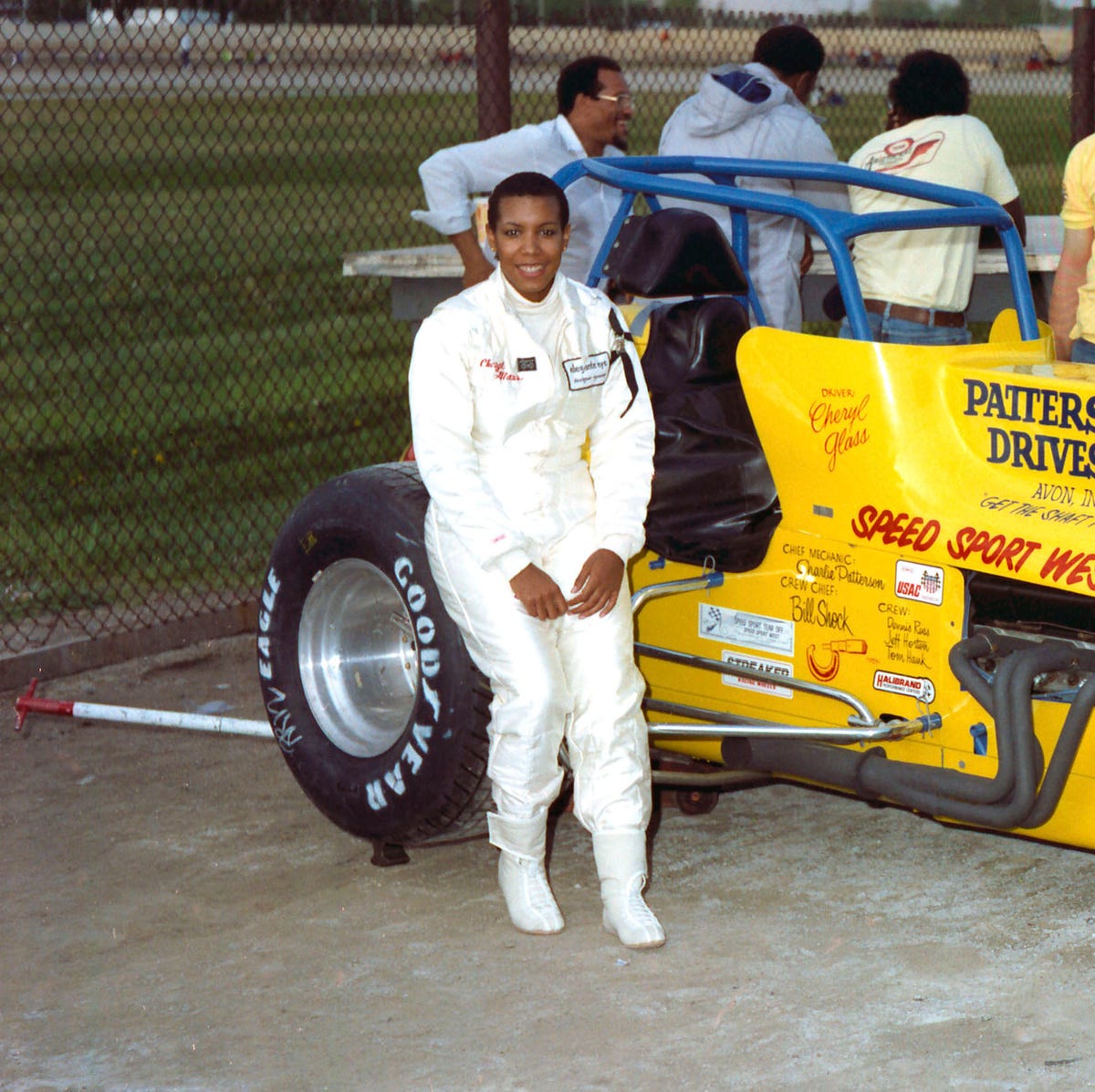
Bio Excerpt: Cheryl Linn Glass made history as America’s first African-American female professional race car driver, earning the nickname “The First Lady of Dirt” through sheer talent and unbreakable determination. She became the first woman to win a sprint car main event, leading the final 25 laps in... (full bio below ↓↓)
Cheryl Linn Glass
Dirt Oval racer
click to enlarge
Cheryl's Socials:

Cheryl's Details:
Cheryl's Sponsors:
YOUR SPONSORS LOGOS HERE
YOUR SPONSORS LOGOS HERE
YOUR SPONSORS LOGOS HERE
Cheryl NEWS:
Cheryl on YouTube:
Cheryl's full bio:
Cheryl Linn Glass was America’s first African-American female professional race car driver, a trailblazer who carved her name into motorsports history with fearlessness, intelligence, and an unshakeable dream of racing at Indianapolis.
EARLY YEARS
Born December 24, 1961, in California, Cheryl Linn Glass moved to Washington State where she grew up in a family that valued both achievement and breaking barriers. Her father was a vice president at Pacific Northwest Bell, and her mother, Shirley, was an engineer at Boeing—one of the first African-American women to hold such a position. Both parents had earned electrical engineering degrees in 1959, setting a standard of excellence that would define their daughter’s life. Cheryl’s mother co-founded the Minority Engineering Retention Program (later the Minority Science and Engineering Program) at the University of Washington, ensuring that the path she and her husband blazed would remain open for others.
Cheryl attended the private Bush School in Seattle from 1968 to 1975, where her mother was actively involved in school activities. She later graduated with honors from Nathan Hale High School at just 16 years old, then enrolled at Seattle University to study electrical engineering, following in her parents’ footsteps. Though she didn’t complete her degree, preferring to focus on her burgeoning racing career, her intelligence and ambition were never in question.
Her racing career began at age nine with quarter-midgets, and she funded her passion through her own entrepreneurial ventures—making and selling high-end ceramic dolls to local businesses like Frederick & Nelson. By 18, she had moved up to the heavier, faster half-midgets, competing on a regional level throughout Washington State.
OTHER INTERESTS
Glass wasn’t just a racer—she was a Renaissance woman with style to spare. At age seven, she took her first modeling class at the Bon Marche’s Cinderella Modeling Class, and her striking, angular face made her a natural. Beyond the track, she opened and ran a wedding design studio and catering service in Seattle’s Pioneer Square. The business was a labor of love, and when she married Richard Lindwall in February 1983, she designed her own wedding dress—a creation that took months to make with her family and was later appraised at $18,000. The wedding was so elaborate it was dubbed “The Wedding of the Year.”
Her creative and business ventures showed a woman who refused to be defined by a single passion, even as racing remained her primary focus.
EARLY SUCCESS
Glass made her mark early, becoming the first woman—and the first African-American woman—to compete at nearly every track she visited in the Pacific Northwest. She won her first sprint car main event leading the final 25 of 35 laps, a historic achievement as the first woman to win such a race. Her talent and tenacity quickly earned her the nickname “The First Lady of Dirt.”
In 1980, she ventured to the Southwest for a run in non-winged sprint cars at Arizona’s Manzanita Raceway, expanding her reach beyond the regional circuit. By 1982, she made her USAC debut at the Hulman Hundred, becoming the first African-American woman to compete with the series. That same year, she raced at the Knoxville Nationals, making it to the C Main—another first for a woman at the prestigious event.
Her ambitions were clear: she wanted to go all the way to the Indianapolis 500, and she had the skill and determination to make it happen.
NOTABLE ACHIEVEMENTS
- 1970s: Won her first sprint car main event, becoming the first woman to win such a race[1].
- 1980: Competed in non-winged sprint cars at Manzanita Raceway in Arizona, including the Western World Championships[2].
- 1982: Made USAC debut at the Hulman Hundred as the first African-American woman to compete with the series[3].
- 1982: Became the first woman to race in the Knoxville Nationals, advancing to the C Main[4].
- 1987: Received the Candace Award as a Trailblazer, recognizing her as the first Black female American racing driver[5].
- 1990: Entered the penultimate round of the CART American Racing Series (Indy Lights) at Nazareth, finishing seventh[6].
INSPIRATIONS
Glass drew inspiration from her parents’ achievements and their commitment to opening doors for others. Her mother’s pioneering work as an engineer at Boeing and her father’s leadership role at Pacific Northwest Bell showed her that barriers were meant to be broken. She carried that ethos onto the track, where she refused to let gender or race define her limits. Her fearlessness, self-confidence, and intelligence were matched only by her work ethic—she funded her own racing through creative entrepreneurship and sheer determination.
REPUTATION
Cheryl Linn Glass was known as a driver who commanded respect—not because she demanded it, but because she earned it. Fellow racers recognized her skill and determination, even when the odds were stacked against her. At the 1990 Nazareth race, drivers Robbie and Mike Groff saw her struggling in practice and offered their help, a testament to the camaraderie she inspired despite being an outsider in so many ways. She was beloved in the Washington racing community and admired nationally as a trailblazer who refused to back down.
Her reputation extended beyond racing. The Candace Award she received in 1987 recognized her not just as a competitor, but as a trailblazer whose impact would be felt for generations.
FUTURE GOALS/PLANS
Cheryl Linn Glass’s life was tragically cut short on July 15, 1997, when her body was found in Seattle’s Lake Union below the Aurora Bridge. She was 35 years old. Detectives ruled her death a suicide, though no note was ever found, and questions surrounding the circumstances remain. Her last race had been on April 21, 1991, at Phoenix International Raceway, which ended in a crash. This section honors her memory rather than future plans that will never be realized.
REFERENCES
Cheryl Glass – Wikipedia
The First Lady of Dirt: The Triumphs and Tragedy of Cheryl Glass – Racing Archives
Cheryl Linn Glass (She/Her) – UW Pressbooks
The Life and Death of Cheryl Glass – Road & Track
Glass, Cheryl Linn (1961-1997) – HistoryLink.org
Cheryl Glass – Speedqueens
Cheryl Glass – Museum of American Speed
Cheryl Linn Glass; She Accomplished Much In A Short Life – Seattle Times