Bio Excerpt: Clara Marian Wagner became the first female Federation of American Motorcyclists member at 15, then scored perfectly in the 1910 Chicago-to-Indianapolis endurance race but was denied her trophy by officials who couldn’t handle being beaten by a girl.— (full bio below ↓↓)
Clara Wagner
Motorcycle racer // American
click to enlarge
Clara's Socials:
Clara's Details:
Clara's Sponsors:
YOUR SPONSORS LOGOS HERE
YOUR SPONSORS LOGOS HERE
YOUR SPONSORS LOGOS HERE
Clara on YouTube:
Clara's bio:
Clara Marian Wagner was one of the first documented women motorcyclists and endurance racers who proved she could outride the boys—only to be denied the trophy she rightfully earned.
EARLY YEARS
Born on November 11, 1891, in Minnesota, Clara grew up with motor oil practically running through her veins. Her father, George Wagner, owned the Wagner Motorcycle Company in Saint Paul, an enterprise he’d established in 1901 as an offshoot of his former bicycle business[1]. While most teenage girls were learning needlepoint, 15-year-old Clara was joining the Federation of American Motorcyclists (FAM) in the spring of 1907, becoming the organization’s first female member[2]. It was a bold move for a girl in an era when women were still fighting for the right to vote, but Clara wasn’t interested in waiting for permission to do what she loved.
Growing up in her father’s motorcycle company gave Clara access to machines and a mechanical education most women of her generation could only dream about. The Wagner Motorcycle Company was producing quality bikes, and Clara became its most valuable asset—not as a secretary or bookkeeper, but as a rider who could prove what those motorcycles could do.
OTHER INTERESTS
Beyond motorcycles, details of Clara’s other interests remain frustratingly scarce in the historical record. What we do know is that she eventually embraced family life, marrying lawyer Walter Henry Jacke on September 13, 1916, in Saint Paul[3]. Over the next twelve years, she became the mother of four children—at least one son and three daughters[4]. It’s likely that motherhood, along with the social expectations of the era, shifted her focus away from competitive racing. But the competitive fire that drove her to challenge men on the track suggests she approached everything in life with the same determination.
EARLY SUCCESS
Clara didn’t ease into motorcycle competition—she blazed into it. Her participation in multiple cross-country races and endurance competitions throughout the late 1900s and early 1910s marked her as a serious competitor, not just a novelty act[5]. The Eclipse Machine Co., a bicycle company that provided brake products, sponsored her racing efforts, recognizing that Clara’s skills were worth backing[6].
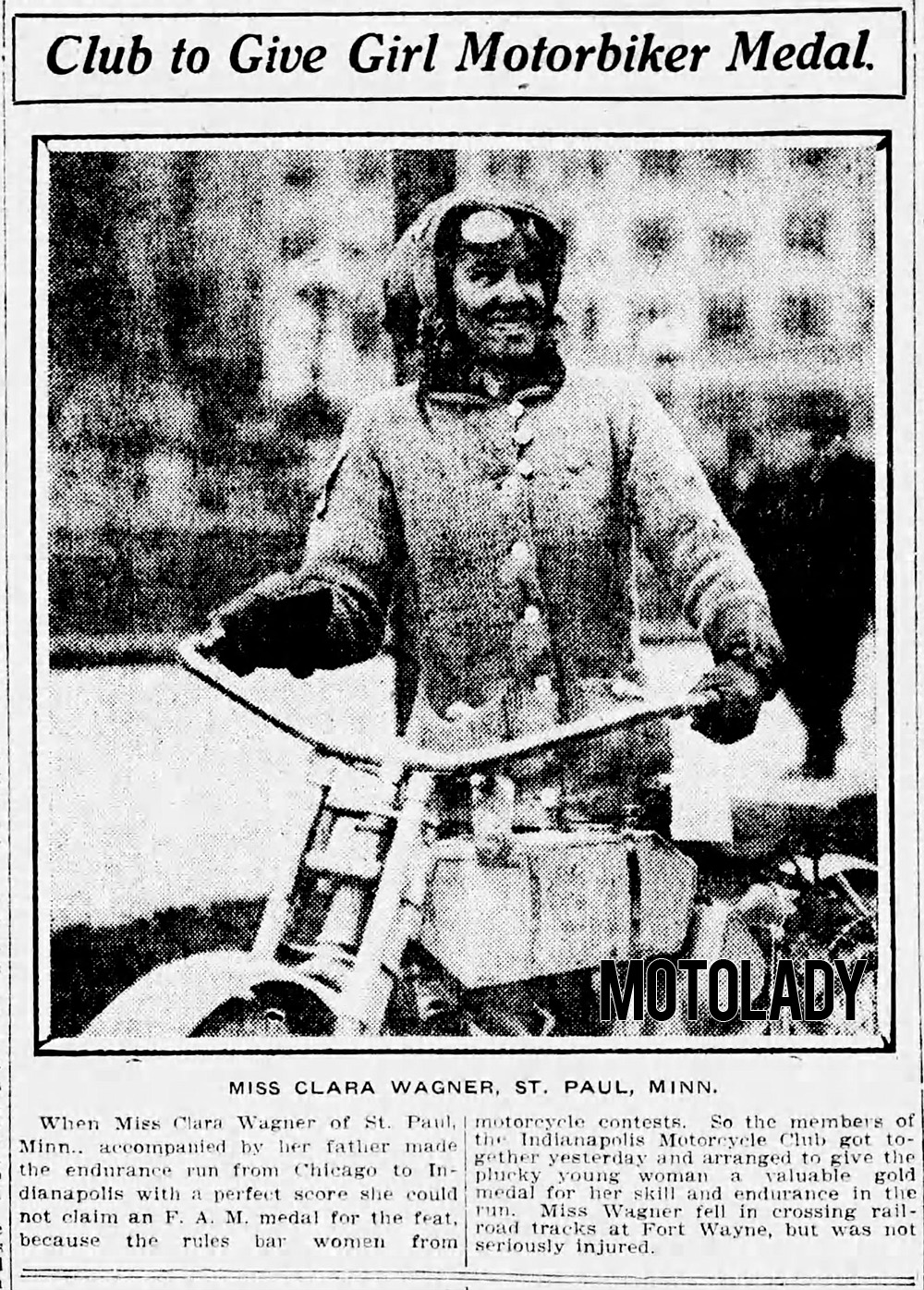
But it was October 1910 that cemented her place in history. At just 18 years old, she entered the grueling FAM Western Endurance Run, a 365-mile slog from Chicago to Indianapolis on a four-horsepower motorcycle[7]. The route was punishing, the conditions were brutal, and Clara was competing against dozens of experienced male riders. She didn’t just complete the race—she achieved a perfect score, outperforming most of her male competitors[8]. It should have been her moment of triumph, a clear victory that proved women belonged in motorsports.
Instead, race officials refused to give her the trophy or official recognition from FAM[9]. The reasons given were thin excuses dressed up as rules, but the message was clear: they hadn’t expected a woman to win, and they weren’t about to let it stand. It was a slap in the face that would have crushed a lesser competitor. Clara, however, had already proven her point. And while the officials withheld her trophy, about 50 of her male competitors—the ones she’d beaten—collectively presented her with a gold pendant in recognition of her achievement[10]. Sometimes respect comes from the people who matter most: your peers.
NOTABLE ACHIEVEMENTS
- 1907: Became the first female member of the Federation of American Motorcyclists (FAM) at age 15[11].
- 1910: Achieved a perfect score in the FAM Western Endurance Run from Chicago to Indianapolis, a 360-mile race, despite being denied official recognition[12].
- 1910: Received a gold pendant from approximately 50 male competitors who collectively honored her perfect score after race officials refused to recognize her achievement[13].
- 1911: Successfully completed numerous cross-country races and endurance competitions, helping put Wagner Motorcycle Company motorcycles on the map[14].
INSPIRATIONS
The historical record doesn’t document who or what inspired Clara to race, but it’s not hard to imagine. Growing up surrounded by her father’s motorcycles, watching them being built and tested, she likely couldn’t resist the pull of the machine. George Wagner clearly supported his daughter’s ambitions—she was riding with his blessing, racing on his company’s bikes, and representing the family business in a way that brought it significant attention. In an era when women were told what they couldn’t do, Clara had a father who apparently believed she could do anything.
REPUTATION
Clara’s reputation was built on results, not rhetoric. Her daughters and newspaper accounts mention numerous wins beyond the famous 1910 endurance run, though detailed records are frustratingly scarce[15]. What’s clear is that she wasn’t a one-hit wonder or a publicity stunt—she was a legitimate competitor who earned respect on the track. The fact that dozens of male riders went out of their way to honor her when the officials wouldn’t speaks volumes about how she was regarded by those who actually raced against her.
She proved that women could compete at the highest levels of motorcycle racing, and she did it without fanfare or melodrama. Clara simply showed up, rode better than almost everyone else, and let her performance do the talking. That the motorcycle establishment tried to erase her victory only makes her accomplishment more significant in retrospect. She was a pioneer whether they acknowledged it or not.
FUTURE GOALS/PLANS
Clara Marian Wagner passed away on December 30, 1961, as Clara Marian Jacke, just over 70 years old and one year after her husband Walter[16]. Her racing days had long since ended, replaced by a life focused on family and the quieter pursuits that came with marriage and motherhood in mid-20th century America. There would be no future goals, no comeback tours, no modern revival. But her legacy lived on in the women who came after her, every one of them benefiting from the door she kicked open back in 1910.
REFERENCES
[1] Wagner Motorcycle Company – Wikipedia
[2] Memories of Yesteryear Part 8 – LPMCC.net
[3] Clara Marian Wagner (1891–1961) – Ancestors Family Search
[4] Clara Marian Wagner (1891–1961) – Ancestors Family Search
[5] Clara Wagner Lives – Wheels Through Time
[6] Women’s Motorcycle History – Utah Rider Ed
[7] For the ladies – AMCA Forum
[8] Clara Wagner – Wikipedia
[9] Clara Wagner: The First Woman to Race Motorcycles? – MotoLady
[10] Women in Transportation History: Clara Wagner, Motorcyclist
[11] Memories of Yesteryear Part 8 – LPMCC.net
[12] Clara Wagner – Wikipedia
[13] Memories of Yesteryear Part 8 – LPMCC.net
[14] Clara Wagner Lives – Wheels Through Time
[15] Clara Wagner: The First Woman to Race Motorcycles? – MotoLady
[16] Clara Wagner: The First Woman to Race Motorcycles? – MotoLady