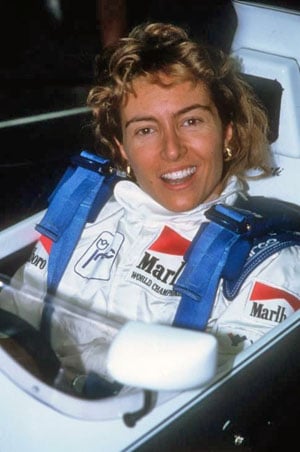
Bio Excerpt: Giovanna Amati carved her name into motorsport history as the last woman to enter a Formula One World Championship Grand Prix—a record that’s stood for over three decades. Born in Rome in 1959, she parlayed early equestrian success into a formidable racing career that began in... (full bio below ↓↓)
Giovanna Amati
Formula racer
click to enlarge
Giovanna's Socials:

I might not have set the track on fire, but I definitely ignited a few sparks in the paddock.
Giovanna's Details:
Giovanna's Sponsors:
YOUR SPONSORS LOGOS HERE
YOUR SPONSORS LOGOS HERE
YOUR SPONSORS LOGOS HERE
Giovanna's full bio:
Giovanna Amati remains the most recent woman to enter a Formula One World Championship Grand Prix—a distinction that has now stood for over three decades and a testament to both her talent and the unforgiving nature of motorsport’s highest level.
EARLY YEARS
Born July 20, 1959, in Rome, Italy, Amati grew up in the kind of wealthy background that made racing financially possible—though it certainly didn’t make it easy. As a teenager with a need for speed already coursing through her veins, she’d make the trip to Vallelunga circuit near Rome to watch Elio de Angelis tear up the track. That proximity to proper racing, combined with money and moxie, set the stage for what would become a groundbreaking career.
But before she ever touched a racing car, eight-year-old Giovanna was already chasing adrenaline on horseback. Equestrian show jumping became her first competitive outlet, molding the discipline and fearlessness that would later define her racing. It was a childhood dream of competition and speed—just with four legs instead of four wheels.
Then, in 1978, her life took a dark and terrifying turn when she was kidnapped. Her family paid an 800 million lira ransom to secure her release. It’s the kind of trauma that could derail anyone, but Amati emerged with her resolve intact, if not hardened.
Her entry into motorsport came through Elio de Angelis himself, the very driver she’d idolized from the grandstands. He encouraged her to join the Henry Morrogh racing drivers school at Vallelunga, and she took to it immediately. The two developed their skills together at a motor racing school, forming a friendship that would prove instrumental in launching her career. By 1981, Amati was ready to go professional.
OTHER INTERESTS
Beyond the circuits, Amati kept her cards close. Her equestrian background in show jumping competitions remained part of her athletic foundation, but details about hobbies, creative pursuits, or life outside the cockpit remain largely private. She focused her public energy on racing, and that’s where the story stays.
EARLY SUCCESS
Amati kicked off her professional racing career in 1981 in the Formula Abarth series, and she didn’t waste time making an impression. Over four years in the category, from 1981 to 1984, she racked up several wins and proved she had both speed and racecraft. In 1982, she grabbed pole position and set the fastest lap—a statement that she belonged at the front of the grid, not just on it.
From there, she moved up to Italian Formula Three, competing from 1985 to 1986 and notching more victories along the way. Racing for Team Coperchini in a Ralt RT30 in 1985, she posted a seventh-place finish at Vallelunga and fifth at Monza. In 1984, she’d competed in a one-off European Formula Three race at Nogaro in a G.Pirola Ralt RT3, finishing fifteenth. She also took on the prestigious Monaco Formula Three race in a Martini MK45. It wasn’t always dominant, but it was consistent, competitive, and proof that she could hang with the boys in open-wheel racing.
Her Italian F3 results earned her enough attention to secure a test with Benetton at Donington Park—a major opportunity that hinted at bigger things to come. In 1991, she completed a 30-lap test session with Benetton, further cementing her credibility in the paddock.
The natural next step was Formula 3000, the primary feeder series to Formula One. Amati competed in F3000 from 1987 to 1991, with a stint in Japan in 1989. Her first year, 1987, brought limited success, but she improved in 1988. Japan in 1989 proved difficult, but when she returned to Europe in 1990 and 1991, her performances got stronger. She drove for Roni Motorsports in a Reynard 90D and Lola Cosworth in 1990, then moved to GJ Motorsports in a Reynard 91D Cosworth in 1991, qualifying for six rounds. Over three years in Italian F3, she’d accumulated a handful of championship points—not a title charge, but enough to keep doors opening. She frequently finished in the top ten in F3000, grabbed poles, and stood on podiums, even finishing third in the overall world standings in an unspecified series. It was the kind of résumé that, combined with financial backing, could buy a shot at Formula One.
NOTABLE ACHIEVEMENTS
- 1981–1984: Multiple race wins in Formula Abarth series.
- 1982: Pole position and fastest lap in Formula Abarth.
- 1985–1986: Race victories in Italian Formula Three.
- 1991: Benetton Formula One test, 30 laps at Donington Park.
- 1992: Entered three Formula One World Championship Grands Prix with Brabham (South Africa, Mexico, Brazil), becoming the fifth woman ever to enter an F1 World Championship event and the first since Desiré Wilson in 1980.
- 1993: Women’s European Champion, Porsche SuperCup.
- 1994–1996, 1998: Competed in Ferrari Challenge, driving a Ferrari 355.
- 1995: Raced Callaway Corvette at 4-hour races at Paul Ricard and Monza (retired).
- 1998: Competed in Sebring 12 Hours and International Sports Racing Series.
- 1999: Third place in SR2 class, SportsRacing World Cup.
INSPIRATIONS
Elio de Angelis wasn’t just an inspiration—he was a friend, a mentor, and the reason Amati ever got behind the wheel of a racing car in the first place. Watching him race as a teenager lit the fire; his encouragement to attend racing school fanned the flames. Their friendship and shared time at the motor racing school gave her both the technical foundation and the belief that she could make it in a male-dominated sport. De Angelis was the catalyst, and his influence runs through every lap of her career.
REPUTATION
Amati earned a reputation for having a forceful personality, innate talent, and genuine skillful prowess on track. Her competitive edge was proven through consistent top-ten finishes, pole positions, and podiums across multiple series. She wasn’t just there to make up the numbers—she was there to race, and she did it with the kind of aggression and commitment that earns respect in the paddock.
Her 1992 Formula One campaign with Brabham, however, became both her greatest achievement and her most public disappointment. The announcement of her signing earned significant publicity for the struggling team, but the reality was brutal. She entered three Grands Prix—South Africa (where her seat was still being made during her first entry), Mexico, and Brazil—but never made it to the starting grid. The Brabham BT60B was unreliable, uncompetitive, and ultimately undrivable. After the Brazilian Grand Prix, she was sacked and replaced by Damon Hill, who would go on to become World Champion. It was a harsh end to her F1 dream, but it wasn’t a reflection of her talent—just the cruel economics and politics of the sport.
Still, the fact remains: Amati is the last woman to enter a Formula One World Championship Grand Prix. That was over 30 years ago. The statistic is both a point of pride and a damning indictment of how little progress has been made for women at the top level of motorsport since.
FUTURE GOALS/PLANS
No current racing activities, team commitments, or future plans are documented for 2025 and beyond.
References:
Giovanna Amati – Formula One History
Giovanna Amati – MSM Group
Amati Biography – Scribd
Women in Formula One – The Drive
Giovanna Amati – F1 Forgotten Drivers
Giovanna Amati – Women in Racing
Giovanna Amati and Elio de Angelis – RaceFans
30 Years Since Amati – Motor Sport Magazine