Bio Excerpt: Mariette Hélène Delangle transformed herself from Parisian cabaret dancer to “Hellé Nice,” the fearless Bugatti Queen of 1930s Grand Prix racing. After a skiing injury ended her stage career, she conquered motorsport with stunning speed. She won her debut race at Montlhéry in 1929, set the... (full bio below ↓↓)
Hellé Nice
Formula racer
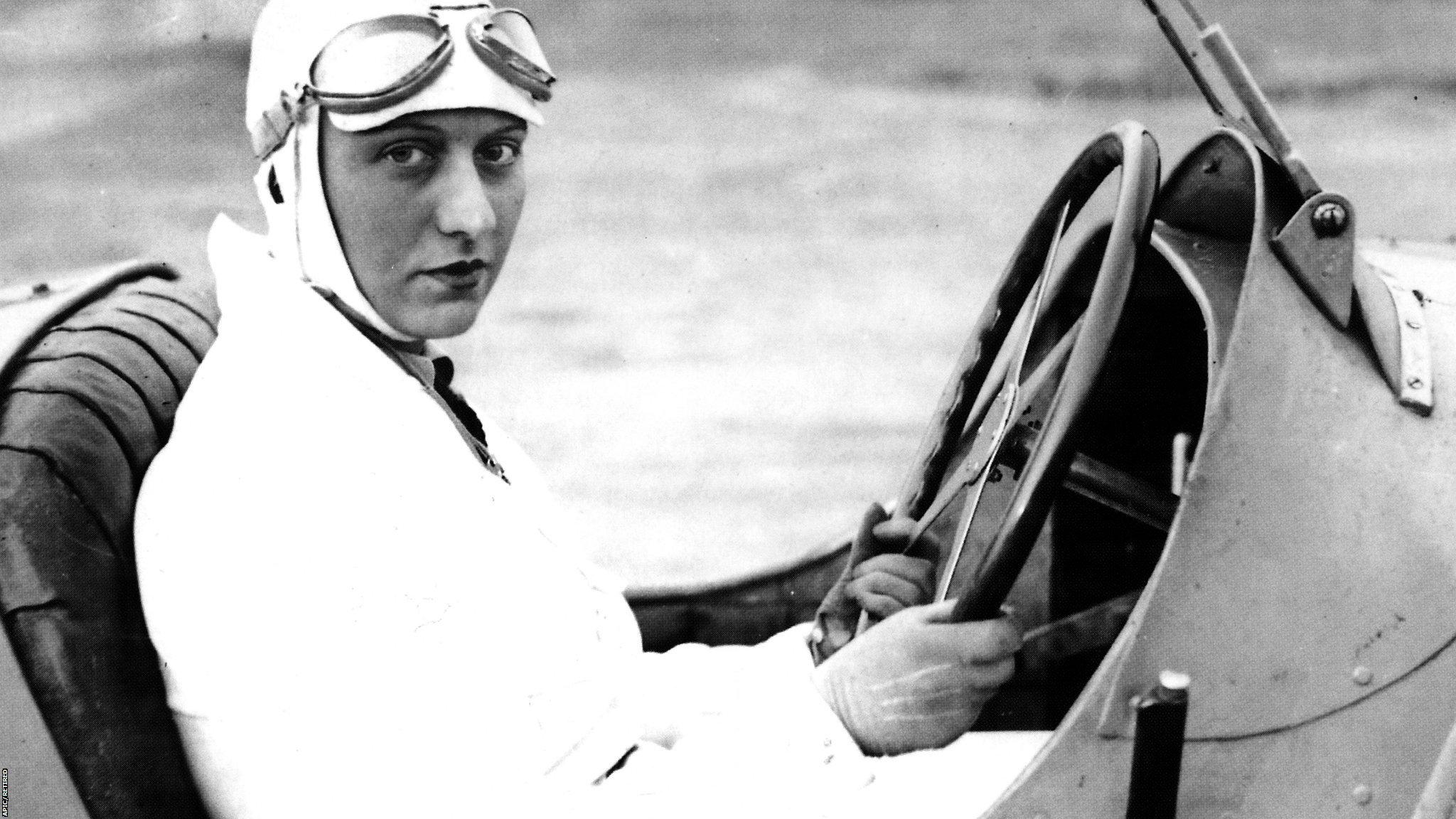
click to enlarge
Hellé's Socials:
It’s all I ever ask for, just to show what I can do, without a handicap, against men
Hellé's Details:
Hellé's Sponsors:
YOUR SPONSORS LOGOS HERE
YOUR SPONSORS LOGOS HERE
YOUR SPONSORS LOGOS HERE
Hellé's full bio:
Mariette Hélène Delangle, better known as Hellé Nice, went from Parisian cabaret stages to becoming one of the most daring Grand Prix drivers of the 1930s—a woman who fearlessly raced Bugattis against men and lived to tell the tale.
EARLY YEARS
Born on December 15, 1900, in Aunay-sous-Auneau, France, Mariette Hélène Delangle was the youngest of five children. Her father, Léon Aristide Delangle, worked as the village postman, and her mother was Alexandrine Estelle. At sixteen, she broke free from her quiet provincial life and headed to Paris, where she reinvented herself as a dancer and performer. She adopted the stage name Hélène Nice, which eventually evolved into the more memorable Hellé Nice—a name that would become synonymous with speed and fearlessness.
OTHER INTERESTS
Before she ever touched a racing car, Hellé Nice was making waves in Paris as a dancer, model, and trapeze artist. She performed at some of the city’s most famous venues and became known for her beauty and daring performances. But in the late 1920s, a serious skiing accident at Megève changed everything. She injured the cartilage in her knee while skiing off-piste, an injury severe enough to threaten her dancing career. After taking a year to recover, she did perform again, but the damage was done. Not one to sit around feeling sorry for herself, she discovered a new passion that would define the rest of her life: motor racing.
EARLY SUCCESS
In 1929, Hellé decided to become a professional racing driver. Her lover at the time introduced her to the world of motorsport, and she took to it immediately. She made her debut at the Autodrome de Linas-Montlhéry in a women-only Grand Prix, driving an Omega-Six—and she won. That same year, she also won the Actor’s Championship, proving she wasn’t just a novelty act. Already famous in Paris for her stage work, she became a household name in France as a racing driver. In 1930, she traveled to the United States to race supercharged Miller cars on dirt tracks, initially signed as a salaried exhibition driver. She quickly proved she could compete with the men, and her reputation grew on both sides of the Atlantic.
NOTABLE ACHIEVEMENTS
- 1929: Won the Grand Prix Féminin at Montlhéry driving an Omega-Six.
- 1929: Won the Actor’s Championship.
- 1930: Set the women’s world land speed record at Montlhéry, recording 120 mph on her fastest lap and earning the nickname “Queen of Speed.”
- 1931: Drove a Bugatti Type 35C in five major Grands Prix across France.
- 1933: Survived a harrowing crash after skidding on black ice during the Monte Carlo Rally and landing in a canal.
- 1936: Won the Coupe des Dames at the Rallye de Monte-Carlo driving a Ford.
- 1936: Survived a catastrophic crash at the São Paulo Grand Prix in Brazil that killed five spectators; she was thrown from her car but remarkably recovered, becoming a national hero in Brazil.
INSPIRATIONS
Hellé Nice was driven by a desire to prove herself in a male-dominated world. “I’ll do better next time,” she said after one race. “It’s all I ever ask for, just to show what I can do, without a handicap, against men.” She raced over her career in 78 Grand Prix, along with numerous hillclimbs, rallies, and endurance trials. Her courage wasn’t just about winning—it was about showing up, again and again, no matter the odds. She drove some of the most iconic racing machines of her era, including the legendary Bugatti Type 35, and signed major sponsorship deals with companies like Esso, becoming known as the “Bugatti Queen.” Wealthy and globally famous by the mid-1930s, she was a trailblazer who inspired countless racers who came after her.
REPUTATION
By the early 1930s, Hellé Nice was one of the most famous female racing drivers in the world. She was glamorous, fearless, and fast—a combination that made her a media sensation. But her career came to a devastating end in 1949 when fellow driver Louis Chiron accused her of being a Gestapo collaborator during World War II. The allegations were never proven, but the damage was done. She was ostracized from the racing community and never competed again. After the war, she also suffered severe bouts of amnesia due to injuries sustained during the conflict, which made driving dangerous. She spent her final years living in poverty in Nice, estranged from her family and supported by the charity La Roue Tourne. She died on October 1, 1984, largely forgotten by the world that once celebrated her.
FUTURE GOALS/PLANS
Hellé Nice passed away in 1984, but her legacy has been rediscovered in recent years. In 2005, a biography by Miranda Seymour brought her story back into the spotlight. In 2010, the Hellé Nice Foundation held a Service of Commemoration and placed a bronze plaque at her formerly unmarked grave. In 2019, a permanent marker was unveiled in Sainte-Mesme, France, honoring the “Bugatti Queen.” Her name lives on in Brazil, where “Hellenice” and “Ellenice” remain popular girls’ names, a tribute to her strength and resilience after the 1936 São Paulo crash.
REFERENCES
Hellé Nice – Wikipedia
The story of Hellé Nice the Grand Prix racing pioneer – Carsales
Hellé Nice – a forgotten hero of pre-war motor racing rediscovered
HELLÉ NICE – FEARLESS BEAUTY BEHIND THE WHEEL
Women in Motorsport & Social History: Helle Nice – Beaulieu
The Former Cabaret Dancer Who Became ‘The Bugatti Queen’
Legendary Ladies Of Motorsport: Hellé Nice – Petrolicious
Helle Nice – The Bugatti Queen – Gearstick & Clutchbag
Legends of Motorsports: Hellé Nice – Hagerty
Hellé Nice Marker Unveiled at Sainte-Mesme, France
Hellé Nice: La Femme Rapide – Hemmings
Bugatti Queen: In Search of a French Racing Legend – Goodreads