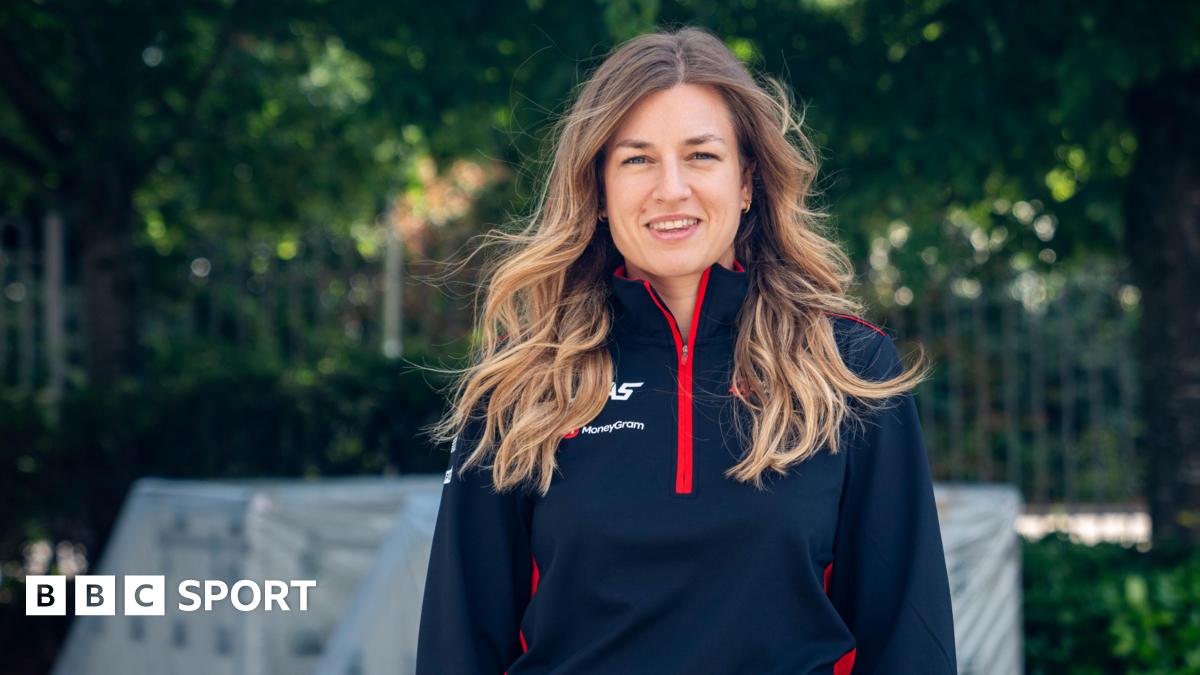
Bio Excerpt: Laura Müller made history in 2025 as Formula 1’s first full-time female race engineer, stepping into the role with Esteban Ocon at MoneyGram Haas F1 Team after an eleven-year climb through motorsport’s technical ladder. The Swiss-born German automotive engineer earned her stripes the hard way—starting as... (full bio below ↓↓)
Laura Muller
Formula racer
click to enlarge
Laura's Socials:
Laura's Details:
Laura's Sponsors:
YOUR SPONSORS LOGOS HERE
YOUR SPONSORS LOGOS HERE
YOUR SPONSORS LOGOS HERE
Laura's full bio:
Laura Müller is a Swiss-born German automotive engineer who made history in 2025 as Formula 1’s first full-time female race engineer, working with Esteban Ocon at MoneyGram Haas F1 Team after a decade-long career climbing through motorsport’s technical ranks.
EARLY YEARS
Growing up near Lake Constance, Germany, Laura Müller wasn’t exactly the kind of girl tearing around in go-karts from age five. Instead, she was the kind who watched Formula 1 on television and quietly admired the field from a distance—smart enough to know she liked it, but uncertain about how someone like her might actually break in. Her path into motorsport wasn’t linear; it was circuitous, thoughtful, and built on a foundation most racers never bother with: serious academic credentials.
Müller enrolled at the Technical University of Munich to study mechanical engineering, focusing on vehicle dynamics, combustion engines, electric engines, mechanics, physics, and mathematics. “Obviously Mechanical Engineering does a lot of mechanics, physics, maths, all those kinds of things,” she explained in an interview. “Where I studied the Bachelor’s degree was actually four semesters for everybody, the same. So even if you did Chemical Engineering, everybody did the same baseline studies. And then I focused on vehicle dynamics. I did combustion engines, electric engines, all these kinds of things.”[2] She completed both her BSc and MSc at TUM, building the kind of technical foundation that would later prove indispensable in the data-obsessed world of modern racing.
But before she committed fully to the motorsport dream, Müller hit pause. Uncertain about her career path, she took a gap year in Australia—a decision that would unexpectedly crystallize everything. Down under, she found herself immersed in the country’s supercharger car culture, surrounded by people who lived and breathed performance vehicles. It was the spark she needed. “I always watched Formula 1, so I never really studied mechanical engineering to work in car production or something,” she admitted. “I always kind of admired the field of motorsport.”[3] Australia didn’t just confirm her interest; it ignited it.
OTHER INTERESTS
Beyond the racetrack and engineering simulations, Müller’s public profile remains refreshingly low-key. What we know is this: she’s deeply passionate about the technical subjects that underpin her work—vehicle dynamics, combustion and electric engines, the physics and mathematics that make cars go faster. Her academic interests aren’t just credentials on a resume; they’re genuine intellectual pursuits that continue to drive her career. She’s also listed as a motivational speaker, though details about her speaking engagements remain sparse. It’s the kind of understated approach that suggests someone more interested in doing the work than talking about it—though in an industry desperate for female role models, her story speaks loudly enough on its own.
EARLY SUCCESS
In 2014, fresh out of her master’s program, Müller landed her first motorsport role as a data and driver analytics intern at Phoenix Racing GmbH. It wasn’t glamorous, but it was a foot in the door—and in motorsport, that’s everything. Just over a year later, she moved to Josef Kaufmann Racing as an engineer in Formula Renault 2.0, simultaneously taking on data engineering work with JS Engineering BVBA and supporting Brazilian driver Lucas di Grassi in the Brazil Stock Car Championship. She was doing what all aspiring motorsport engineers do: paying her dues, working multiple gigs, honing her skills across different series and technical challenges.
The progression was steady and strategic. A brief one-race stint with DKR Engineering in LMP3 at Paul Ricard for the Le Mans Cup gave way to multiple LMP2 performance engineer roles—DragonSpeed USA LLC in the European Le Mans Series, Racing Team Nederland in the FIA World Endurance Championship, and Algarve Pro Racing. She spent roughly three years as a data and performance engineer with JS Engineering BVBA, building expertise in the kind of endurance racing that demands both technical precision and strategic thinking over marathon stints.
By 2021, Müller had worked her way into a significant milestone: race engineer for Sophia Flörsch at ABT Sportsline GmbH in DTM. Supporting another woman in motorsport felt appropriate, even symbolic—though Müller’s competence, not her gender, secured the position. The following season, she moved to Manthey Racing GmbH as a data and race engineer in GT3, spending nearly two years refining her craft in one of motorsport’s most competitive arenas.
Then came 2022, and the call every engineer dreams of: Formula 1. Haas F1 Team brought her into their simulator department, then promoted her to performance engineer—a role she’d hold for three years, learning the brutal pace and unforgiving standards of the sport’s highest level. She’d honed her skills across LMP2, LMP3, DTM, and GT3; now it was time to prove she belonged in F1.
NOTABLE ACHIEVEMENTS
- 2014: Data and driver analytics intern, Phoenix Racing GmbH[3][5][6].
- ~2015: Engineer, Josef Kaufmann Racing (Formula Renault 2.0); data engineering roles with JS Engineering BVBA and Lucas di Grassi (Brazil Stock Car Championship)[3].
- Multiple years: LMP2 performance engineer roles with DragonSpeed USA LLC (European Le Mans Series), Racing Team Nederland (FIA World Endurance Championship), and Algarve Pro Racing[3][4].
- 2021: Race engineer for Sophia Flörsch, ABT Sportsline GmbH (DTM)[3][4].
- ~2022: Data and race engineer, Manthey Racing GmbH (GT3), nearly two years[2][3][4].
- 2022: Joined Haas F1 Team simulator department, then performance engineer for three years[1][2][4][5][6].
- 2025: Promoted to race engineer for Esteban Ocon, MoneyGram Haas F1 Team—becoming Formula 1’s first full-time female race engineer[1][2][3][4][5][6][7][8].
INSPIRATIONS
Müller grew up watching Formula 1, drawn to the sport’s technical complexity and competitive drama long before she imagined herself as part of it. Her gap year in Australia exposed her to supercharger car culture—a grittier, more visceral side of performance vehicles that cemented her interest. Beyond that, her inspirations remain largely private. What’s clear is that her motivation came less from idolizing specific drivers and more from admiring the field itself: the engineering challenges, the data puzzles, the relentless pursuit of marginal gains that defines modern motorsport.
REPUTATION
In the paddock, Müller is regarded as exceptionally capable—someone who brings dedication, technical insight, and a work ethic that stands out even in a sport defined by obsessive preparation. Haas Team Principal Ayao Komatsu has publicly highlighted both her character and her commitment, the kind of endorsement that carries weight in F1’s tight-knit engineering community. Her expertise spans vehicle dynamics, aerodynamics, data analysis, simulation technologies, and performance strategies—the full technical toolkit required to optimize a modern F1 car.
Media coverage has been overwhelmingly positive, framing her 2025 promotion as a pioneering achievement for women in motorsport engineering. She’s described as a trailblazer, an inspiration for women in STEM and leadership roles, and proof that persistence through the lower rungs of motorsport can lead to the sport’s highest level. No controversies, no conflicts—just steady competence and a barrier-breaking achievement that makes her a role model whether she sought that mantle or not. She worked as race engineer for Sophia Flörsch in DTM, supporting another woman trying to make it in a male-dominated field, which speaks to both her technical credentials and her character.
FUTURE GOALS/PLANS
For 2025, Müller’s focus is singular: supporting Esteban Ocon and MoneyGram Haas F1 Team through the Formula 1 season. It’s her first year as a race engineer at this level, which means proving she can handle the pressure cooker of race weekends, the split-second decisions during pit stops, the strategic chess matches against rival teams, and the constant communication with a driver pushing a car to its absolute limit. Her promotion from performance engineer—a role she held for three years—suggests Haas sees long-term potential, not just a publicity move. Beyond 2025, her goals remain unstated, but the trajectory is clear: she’s not here to be F1’s first female race engineer as a novelty. She’s here to be good at it.
References:
Mane.co.uk Article
Design News Article
Females in Motorsport Article
SAL Racing Article
Female Motivational Speakers Profile
Champions Speakers Profile
NDA Article
Motivational Speakers Agency Profile